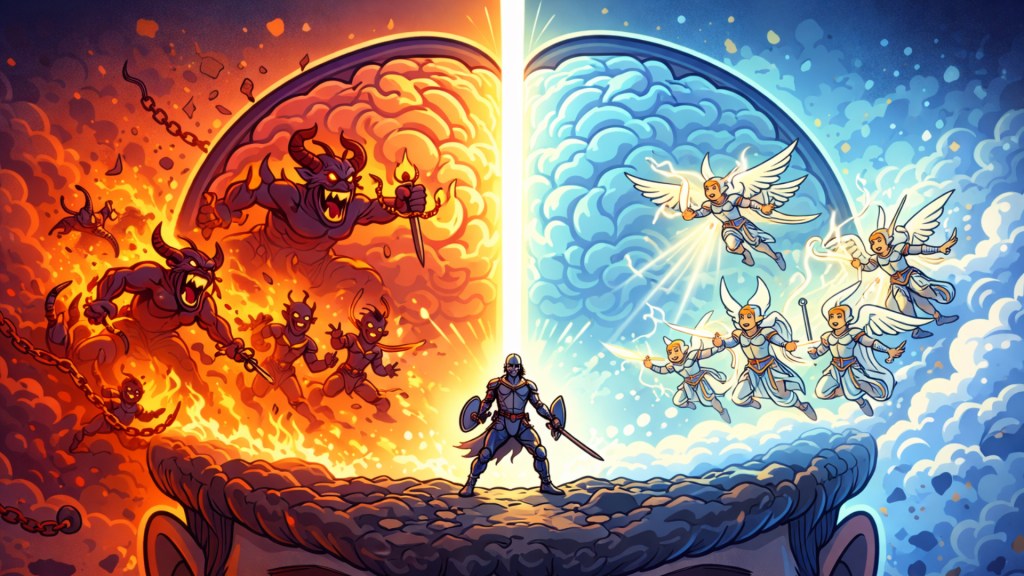
Most people don’t wake up and decide to reject God. They drift. That’s how brainwashing works. It’s passive. It’s slow. It seems normal. You don’t feel captured—you feel enlightened. Believing, on the other hand, is active. It is conscious allegiance. It is a deliberate obedience to Christ, the one who gave himself up for us.
The real danger in life isn’t always open rebellion against God. It’s subtle deception. A gentle nudge in your thinking. A reframing of what God has said. A slight shift that feels harmless at first—until devotion becomes diluted.
That’s how this battle works. It doesn’t begin with a fist raised at heaven. It begins with a question, a reinterpretation, an idea that sounds reasonable enough to entertain.
And once your thoughts begin to wander, your loyalties aren’t far behind. The battlefield isn’t primarily cultural or political. It’s cognitive. The battle is for the mind.
So here’s the question: Are you being conditioned by the world or discipled by the Word?
Paul writes: “I am afraid that as the serpent deceived Eve by his cunning, your thoughts will be led astray from a sincere and pure devotion to Christ” (2 Corinthians 11:3 ESV).
Notice what he targets: your thoughts. Paul is referencing Genesis 3. The serpent doesn’t start with violence. He starts with distortion. “Did God actually say…?” The command was clear. But the enemy reframes it. Twists it. Softens it. Then flat-out contradicts it. The serpent said, “You will not surely die.” And then comes the deeper lie: “You will be like God.” Translation: You don’t need God to define good and evil. You can determine that for yourself. That is the original anti-Christ worldview. Not so much atheism but autonomy.
Fast forward to today. We are catechized daily by a culture that preaches:
* Truth is personal.
* Identity is self-constructed.
* Authority is oppressive.
* Desire is sacred.
That is not neutral messaging. That is formation. And when a generation is discipled into radical autonomy, anxiety follows. When there is no transcendent anchor, everything becomes fragile—including the self.
I noted before that much of the mental health crisis appears connected to ways of thinking. That’s not simplistic. It’s biblical. Worldviews have consequences. If meaning is self-generated, then you carry the unbearable weight of creating yourself.
The enemy still fights with distortion. There is no Geneva Convention in this war. He fights dirty. He aims at the mind. That’s why Paul talks about armor: “take the helmet of salvation” (Ephesians 6:17a). You don’t wear a helmet if there’s no threat to your head. (Shout out to my friend Jerry Pile).
At the core of Genesis 3 is a failure to worship. The serpent offered autonomy over adoration. Self-rule over surrender. When we attempt to define good and evil apart from God, we are not becoming free—we are becoming fragile and vulnerable.
Brainwashed people don’t realize they’re being formed. Believers choose their formation.
If the battle is in the mind, then discipleship must include the intellect.
Not just emotion.
Not just experience.
Not just vibes.
Questions to consider:
* What ideas have I absorbed without examining them?
* What assumptions about truth, identity, and authority have I inherited from culture?
* Am I being shaped by God’s Word—or reshaping it to fit me?
Believing requires intentional renewal. It requires training your thoughts to submit to Christ rather than reimagning Christ to submit to your thoughts.
If you’re going to take every thought captive to obey Christ then here are some steps you’ll want to take.
First, guard your inputs. You’ve heard the old saying, “garbage in, garbage out.” You’re being formed by what you repeatedly consume. Media, entertainment, and algorithms are not neutral. You don’t need to withdraw from the world, but you do need to curate your influences. If your primary teachers are cultural commentators rather than Christ and his Word, don’t be surprised at the outcome. Formation follows repetition.
So, secondly, saturate your thinking with scripture. You can’t recognize distortion if you don’t know the original. The serpent’s tactic was subtle misquotation and strategic reframing. That still works because many believers are spiritually undernourished. A verse here and there won’t anchor you.
Read deeply. Read in context. Read repeatedly. Let Scripture set your categories for truth, goodness, identity, and authority. You can’t counter lies if you’re fuzzy on what God has actually said.
Third, practice slow thinking. Deception thrives in reaction. The culture trains us to respond instantly—to headlines, outrage cycles, and viral content. But wisdom requires pause.
Before accepting an idea, ask: What worldview undergirds this? What vision of the good life does this assume? Where does this end if consistently applied?
Disciplined thinking is slow thinking.
Staying on the path to the flourishing, abundant life God offers isn’t accidental. It is intentional alignment. The mind will drift unless it is directed.
The heart will wander unless it is anchored. Guarding your mind is not fear-based living. It is faithful living.
The battle is real. But so is the grace that trains you to think rightly—and live accordingly.
Video Version: https://youtu.be/8etXTn35-LA






 Flourishing Life
Leave a comment