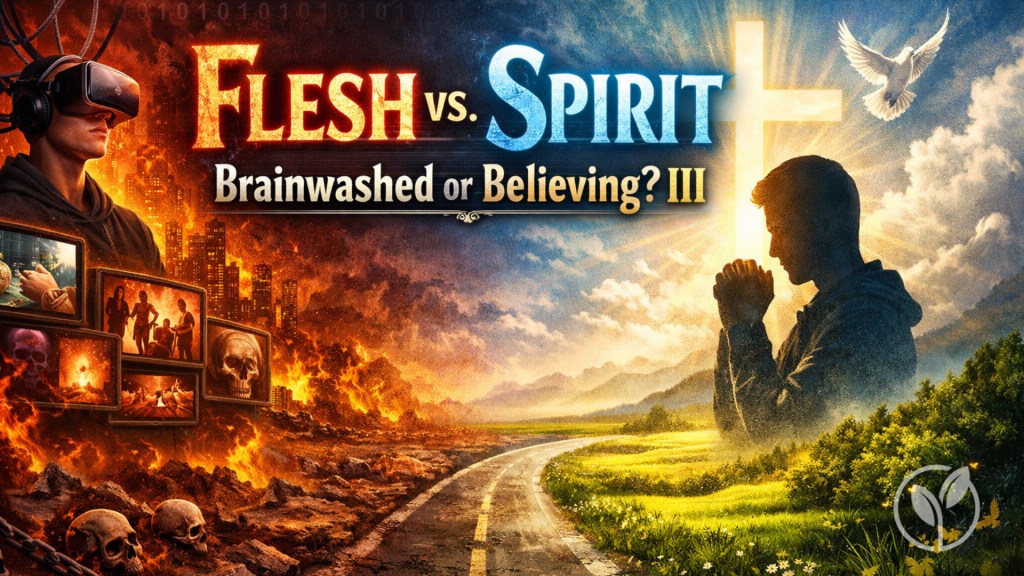
One of the central claims of the Brainwashed or Believing? series is simple: your mind is being shaped whether you realize it or not.
Nobody lives with a neutral mindset. Our assumptions, instincts, and reactions are constantly being formed by something—family, culture, media, habits, experiences, fears, and desires. The real question is not whether your thinking is being shaped. The question is “Who is shaping it?”
The Apostle Paul addresses this directly in Romans 8. His insight cuts below surface behavior. We often treat the Christian life as if it were primarily about behavior modification—trying harder, avoiding certain sins, adopting better habits. But in Romans 8, Paul pushes much deeper. He goes to the level of orientation, allegiance, and realm of existence. He goes straight to the level of mindset—the governing orientation of a person’s life.
What God Has Already Done
Before Paul talks about mindsets, he reminds us of something decisive God has already done. God sent his Son “in the likeness of sinful flesh” and condemned sin in the flesh. In other words, through the Incarnation, the cross, and the resurrection, God passed judgment on the power of sin itself. Sin’s authority was broken in Christ.
The purpose of that act was that the righteous intention of the law—lives aligned with God—might finally be fulfilled in those who walk according to the Spirit.
The Christian life doesn’t begin with human effort. It begins with God’s decisive intervention.
Your Mindset Reveals Your Realm
The heart of the matter is in Romans 8:5-8:
“For those who live according to the flesh set their minds on the things of the flesh, but those who live according to the Spirit set their minds on the things of the Spirit. For to set the mind on the flesh is death, but to set the mind on the Spirit is life and peace. For the mind that is set on the flesh is hostile to God, for it does not submit to God’s law; indeed, it cannot. Those who are in the flesh cannot please God” (ESV).
The key phrase is “set their minds.” Paul isn’t talking about occasional thoughts that pass through your head. He’s describing the inward orientation that shapes how you interpret the world.
What do you assume about life?
What do you instinctively pursue?
What feels obvious or natural to you?
Those instincts reveal the realm from which you are living.
The Flesh: A Mindset of Self-Rule
When Paul uses the word “flesh,” he’s not talking about the physical body. He is describing a way of being human that’s organized around self-rule instead of God’s rule.
The mindset of the flesh sounds familiar because it dominates the cultural air we breathe:
“You define your own truth.”
“Do what makes you happy.”
“You answer to no one but yourself.”
“You’re the center of your story.”
Those ideas feel natural in modern culture. They’re promoted constantly—in advertising, entertainment, social media, and even popular psychology.
But Paul says something startling: this mindset ultimately produces death.
Not necessarily immediate physical death, but spiritual fragmentation—alienation from God, confusion about identity, instability in relationships, and the slow unraveling of the soul.
Why? Because the mindset of the flesh resists God. It refuses to submit to his design for life.
The Spirit: A Mindset of Alignment With God
By contrast, Paul says that the mindset shaped by the Spirit produces “life and peace.”
Where the flesh centers the self, the Spirit re-centers life around Christ. The Spirit reshapes the instincts of the heart:
Instead of “I must control everything,” the Spirit teaches trust.
Instead of “My desires define truth,” the Spirit forms humility.
Instead of “I exist for myself,” the Spirit shapes love and service.
This mindset produces life because it aligns a person with the new creation reality God launched in the resurrection of Jesus.
And it produces peace because the constant inner conflict of self-rule gives way to trust in God.
Why the Spirit Is Necessary
Paul presses the point further. He says the mindset of the flesh does not submit to God’s law—and cannot.
That statement is important.
The problem with the flesh is not simply that it occasionally fails to obey God. The problem is that it fundamentally combats God’s leadership. Which means the solution cannot simply be trying harder. The flesh cannot produce what it resists.
This is why Paul insists that salvation is more than learning better ideas about God. It is more than agreeing with Christian doctrine. Salvation is a change in the governing center of your life.
Not Mere Intellectual Assent, but Transformation
Many people treat faith as intellectual agreement: affirm the right beliefs and you are done. But Paul describes something deeper, a discipleship of the mind. The Spirit does not merely inform your thinking. He reorients your existence.
Your instincts begin to change. Your desires begin to shift. Your perception of what is good begins to realign with God.
In other words, salvation is not merely intellectual assent. It is a new life—a transformation at the most fundamental level of our being. You begin to live from a new center.
Brainwashed or Believing?
This brings us back to the question at the heart of this series. If our mindset reveals the governing center of our being, then we have to ask:
What has shaped the way you think about life?
Have you passively absorbed the assumptions of the surrounding culture?
Or have you intentionally allowed your mind to be reshaped by the Spirit of God?
The difference isn’t small.
According to Paul, one mindset leads to death. The other leads to life and peace. And the dividing line between them is not intelligence, education, or willpower. It is the presence and work of the Holy Spirit.
The Christian life, then, is not about trying harder to behave like a Christian. It is about learning to live empowered by the Spirit, from the new center God has given you.
Check out the video: https://youtu.be/TX5LExIQiHo





 Flourishing Life
Leave a comment