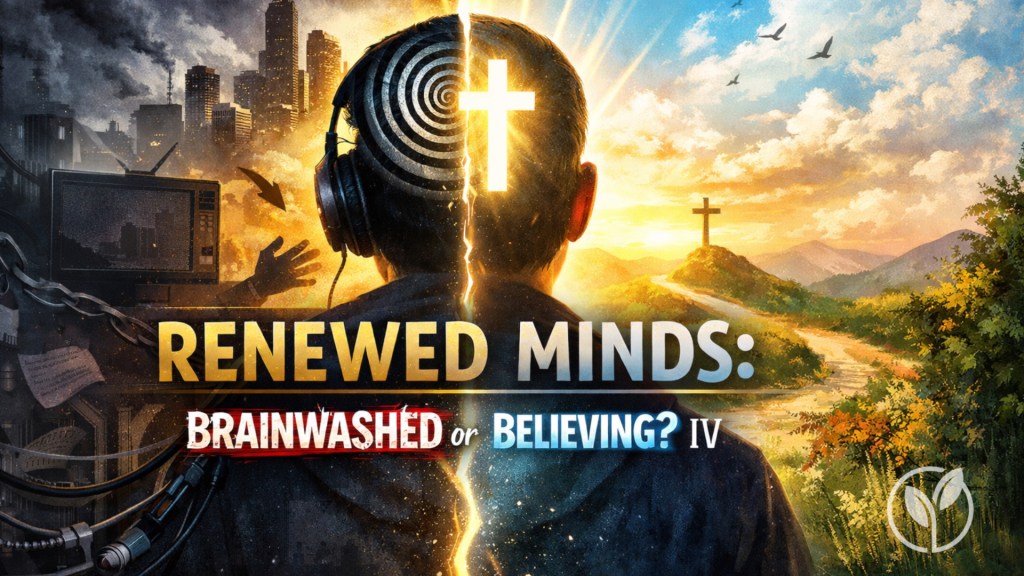
Today we’re wrapping up the Brainwashed or Believing? series. Throughout we’ve returned to a simple but uncomfortable truth: your mind is being shaped whether you realize it or not.
No one lives with a neutral mindset. The world constantly presses its assumptions, fears, desires, and definitions of reality upon us. Culture catechizes. Habits train us. Media forms our thoughts. Over time, a way of thinking settles in. Most people are brainwashed. God calls us to believe, to trust him, turn to his love, and follow his ways.
That is why Paul weighs in with:
“Do not be conformed to this world, but be transformed by the renewal of your mind, that by testing you may discern what is the will of God, what is good and acceptable and perfect.” Romans 12:2 (ESV)
The negative warning matters. Do not be conformed. Do not allow your life to be pressed into the mold of the present age—the fallen world order that lives in rebellion against God.
Earlier in Romans, Paul explained what happens when humanity drifts in that direction:
“For although they knew God, they did not honor him as God or give thanks to him, but they became futile in their thinking, and their foolish hearts were darkened.” Romans 1:21 (ESV)
Notice where the breakdown occurs. Not first in behavior, but in thinking. When our way of seeing reality becomes distorted, our decisions and actions follow. Destructive behavior results from suppressed truth and distorted thinking. The fallen human mind is enslaved to disordered passions.
But what Scripture offers here is not primarily a warning. It is a promise.
Paul says we can be “transformed by the renewal of our minds.”
Renovation, Not Self-Improvement
Think of it like a house renovation.
Anyone who has lived through a major renovation knows how disruptive it can be. Walls get torn out. Wiring has to be replaced. Things that looked fine on the surface turn out to be deeply flawed underneath.
Left alone long enough, structures deteriorate. Systems fail. Repairs become unavoidable.
The same thing happens in the human mind.
Simply by living in this world—and neglecting the loving leadership of the Holy Spirit—our thinking becomes shaped by the assumptions of the age around us. The internal structure of our thinking gets warped. We become confused. That which is wrong and destructive to human flourishing is normalized.
We don’t just need better habits. We need renovation, renewal.
And Paul insists that renovation is not something we accomplish ourselves. His letter to Titus makes this clear:
“But when the goodness and loving kindness of God our Savior appeared, he saved us, not because of works done by us in righteousness, but according to his own mercy, by the washing of regeneration and renewal of the Holy Spirit, whom he poured out on us richly through Jesus Christ our Savior.” Titus 3:4-6 (ESV)
The renewal of the mind is the work of the Holy Spirit. It’s not self-construction; it is divine renovation.
Our role is not to rebuild the house ourselves. Our role is to submit to the master builder.
A Mindset Revolution
This is why the Christian life is far deeper than behavior modification.
Many assume Christianity is mainly about trying harder to obey rules. But Paul goes beneath behavior to the level of mindset—the governing orientation of a person’s life.
When the Spirit renews the mind, something fundamental shifts. We begin to perceive reality differently. The word translated as “renewal” implies making the mind new in character, aligning one’s thinking with the mind of Christ.
The world teaches us to center life around the self. The Spirit recenters life around Christ. The world tells us to define truth by desire. The Spirit forms humility and receptivity to God. The world teaches control, anxiety, and self-protection. The Spirit cultivates trust, gratitude, and love.
Virtuous behavior flows out of this renewed mindset. It’s the fruit of a life whose thinking has been reshaped.
Living According to the Age to Come
Paul’s instruction can be summarized like this:
Do not let your life be shaped by the values, assumptions, and patterns of the present fallen world order.
Instead:
Live according to the new creation reality launched in the resurrection of Jesus. Think according to the age to come that is breaking into this present, fallen age. Allow the Holy Spirit to continually renew your mind.
This is the divine-human partnership of spiritual maturity. The Spirit does the renewing work. We cooperate by yielding, listening, and aligning our lives with what he is doing.
Over time, the result is remarkable.
Our instincts change.
Our reactions change.
Our desires change.
And gradually we become able to “discern what is the will of God—what is good and acceptable and perfect” (Romans 12:2).
What a Renewed Mind Looks Like
A renewed mind begins to see reality through the lens of God’s goodness and leadership.
Gratitude replaces entitlement.
Trust displaces anxiety.
Humility replaces the constant need to justify ourselves.
Love guides decisions rather than self-protection.
This renewed way of thinking also changes how we interpret our circumstances.
Where the old mindset asks, “How does this affect me?” the renewed mind asks, “How might God be at work here?”
Where the old mindset assumes scarcity and competition, the renewed mind sees God as generous and faithful and in control.
Over time, the Spirit forms a deeper stability within a person. The constant internal turbulence of self-rule begins to settle. The mind becomes less reactive, less defensive, less driven by fear or pride.
Paul connects the renewal of the mind with the ability to discern the will of God. The word Paul uses carries the idea of testing and recognizing what is genuine. A renewed mind develops the ability to evaluate the ideas, values, and instincts that constantly press upon us.
In the fallen world order, many things present themselves as good—status, autonomy, the freedom to define truth for ourselves. The assumptions of this age often feel natural simply because we have breathed that air for so long.
But the Spirit renews our thinking so we can perceive truth more clearly.
We begin to recognize the difference between what merely appears desirable in the present age and what is actually good, acceptable, and perfect in the in-breaking kingdom of God.
Discernment means learning to recognize God’s character and deliberately aligning our decisions with his loving leadership.
Does this align with the holiness of Christ?
Does it reflect the love of Christ?
Does it move toward the life of the new creation God is bringing about?
The more the Spirit renews our minds, the more instinctively we recognize what fits within God’s purposes versus what belongs to the old, fading order.
In other words, the renewed mind begins to think in ways that reflect the character and wisdom of Christ himself.
And that renewed way of thinking inevitably leads to a choice between two paths.
The Two Ways
Scripture consistently describes life in terms of two paths:
There is the way of life.
And there is the way of death.
In the next series, we will explore this ancient biblical theme. From Deuteronomy to the Psalms, from the teachings of Jesus to the early church, God repeatedly invites us to choose the path that leads to life.Today we’re wrapping up the Brainwashed or Believing? series. Throughout we’ve returned to a simple but uncomfortable truth: your mind is being shaped whether you realize it or not.
No one lives with a neutral mindset. The world constantly presses its assumptions, fears, desires, and definitions of reality upon us. Culture catechizes. Habits train us. Media forms our thoughts. Over time, a way of thinking settles in. Most people are brainwashed. God calls us to believe, to trust him, turn to his love, and follow his ways.
That is why Paul weighs in with:
“Do not be conformed to this world, but be transformed by the renewal of your mind, that by testing you may discern what is the will of God, what is good and acceptable and perfect.” Romans 12:2 (ESV)
The negative warning matters. Do not be conformed. Do not allow your life to be pressed into the mold of the present age—the fallen world order that lives in rebellion against God.
Earlier in Romans, Paul explained what happens when humanity drifts in that direction:
“For although they knew God, they did not honor him as God or give thanks to him, but they became futile in their thinking, and their foolish hearts were darkened.” Romans 1:21 (ESV)
Notice where the breakdown occurs. Not first in behavior, but in thinking. When our way of seeing reality becomes distorted, our decisions and actions follow. Destructive behavior results from suppressed truth and distorted thinking. The fallen human mind is enslaved to disordered passions.
But what Scripture offers here is not primarily a warning. It is a promise.
Paul says we can be “transformed by the renewal of our minds.”
Renovation, Not Self-Improvement
Think of it like a house renovation.
Anyone who has lived through a major renovation knows how disruptive it can be. Walls get torn out. Wiring has to be replaced. Things that looked fine on the surface turn out to be deeply flawed underneath.
Left alone long enough, structures deteriorate. Systems fail. Repairs become unavoidable.
The same thing happens in the human mind.
Simply by living in this world—and neglecting the loving leadership of the Holy Spirit—our thinking becomes shaped by the assumptions of the age around us. The internal structure of our thinking gets warped. We become confused. That which is wrong and destructive to human flourishing is normalized.
We don’t just need better habits. We need renovation, renewal.
And Paul insists that renovation is not something we accomplish ourselves. His letter to Titus makes this clear:
“But when the goodness and loving kindness of God our Savior appeared, he saved us, not because of works done by us in righteousness, but according to his own mercy, by the washing of regeneration and renewal of the Holy Spirit, whom he poured out on us richly through Jesus Christ our Savior.” Titus 3:4-6 (ESV)
The renewal of the mind is the work of the Holy Spirit. It’s not self-construction; it is divine renovation.
Our role is not to rebuild the house ourselves. Our role is to submit to the master builder.
A Mindset Revolution
This is why the Christian life is far deeper than behavior modification.
Many assume Christianity is mainly about trying harder to obey rules. But Paul goes beneath behavior to the level of mindset—the governing orientation of a person’s life.
When the Spirit renews the mind, something fundamental shifts. We begin to perceive reality differently. The word translated as “renewal” implies making the mind new in character, aligning one’s thinking with the mind of Christ.
The world teaches us to center life around the self. The Spirit recenters life around Christ. The world tells us to define truth by desire. The Spirit forms humility and receptivity to God. The world teaches control, anxiety, and self-protection. The Spirit cultivates trust, gratitude, and love.
Virtuous behavior flows out of this renewed mindset. It’s the fruit of a life whose thinking has been reshaped.
Living According to the Age to Come
Paul’s instruction can be summarized like this:
Do not let your life be shaped by the values, assumptions, and patterns of the present fallen world order.
Instead:
Live according to the new creation reality launched in the resurrection of Jesus. Think according to the age to come that is breaking into this present, fallen age. Allow the Holy Spirit to continually renew your mind.
This is the divine-human partnership of spiritual maturity. The Spirit does the renewing work. We cooperate by yielding, listening, and aligning our lives with what he is doing.
Over time, the result is remarkable.
Our instincts change.
Our reactions change.
Our desires change.
And gradually we become able to “discern what is the will of God—what is good and acceptable and perfect” (Romans 12:2).
What a Renewed Mind Looks Like
A renewed mind begins to see reality through the lens of God’s goodness and leadership.
Gratitude replaces entitlement.
Trust displaces anxiety.
Humility replaces the constant need to justify ourselves.
Love guides decisions rather than self-protection.
This renewed way of thinking also changes how we interpret our circumstances.
Where the old mindset asks, “How does this affect me?” the renewed mind asks, “How might God be at work here?”
Where the old mindset assumes scarcity and competition, the renewed mind sees God as generous and faithful and in control.
Over time, the Spirit forms a deeper stability within a person. The constant internal turbulence of self-rule begins to settle. The mind becomes less reactive, less defensive, less driven by fear or pride.
Paul connects the renewal of the mind with the ability to discern the will of God. The word Paul uses carries the idea of testing and recognizing what is genuine. A renewed mind develops the ability to evaluate the ideas, values, and instincts that constantly press upon us.
In the fallen world order, many things present themselves as good—status, autonomy, the freedom to define truth for ourselves. The assumptions of this age often feel natural simply because we have breathed that air for so long.
But the Spirit renews our thinking so we can perceive truth more clearly.
We begin to recognize the difference between what merely appears desirable in the present age and what is actually good, acceptable, and perfect in the in-breaking kingdom of God.
Discernment means learning to recognize God’s character and deliberately aligning our decisions with his loving leadership.
Does this align with the holiness of Christ?
Does it reflect the love of Christ?
Does it move toward the life of the new creation God is bringing about?
The more the Spirit renews our minds, the more instinctively we recognize what fits within God’s purposes versus what belongs to the old, fading order.
In other words, the renewed mind begins to think in ways that reflect the character and wisdom of Christ himself.
And that renewed way of thinking inevitably leads to a choice between two paths.
The Two Ways
Scripture consistently describes life in terms of two paths:
There is the way of life.
And there is the way of death.
In the next series, we will explore this ancient biblical theme. From Deuteronomy to the Psalms, from the teachings of Jesus to the early church, God repeatedly invites us to choose the path that leads to life.
Check out the video version here: https://youtu.be/I0M-XiHng6k




 Flourishing Life
Leave a comment