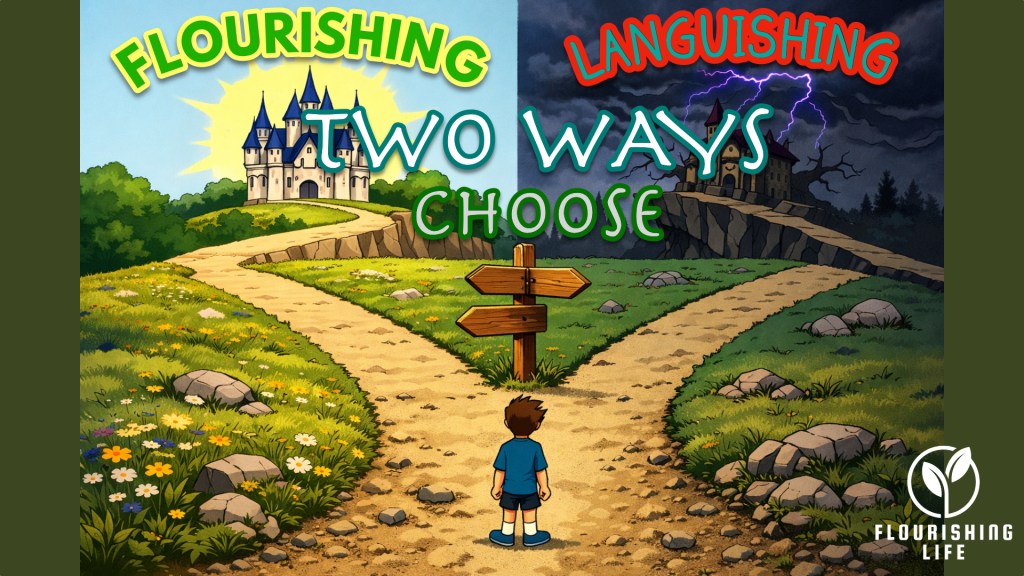
Jesus said there are two ways (Matthew 7:13-14).
One is narrow—and it leads to life. The other is wide—and it leads to destruction. That’s not subtle. That’s not nuanced. That’s a line in the sand.
And then, at the end of that same sermon, he says: You can build your life on rock… or on sand (Matt. 7:24-27). And the difference doesn’t show up when the weather is nice. It shows up when the storm hits.
Now here’s what’s important. Jesus isn’t inventing a new idea here. He’s tapping into something ancient. What biblical scholars call the “Two Ways Tradition.” It’s the idea that life comes down to two paths: The way that leads to life… and the way that leads to death.
And if we’re honest, this connects with something deep in all of us. Because everybody wants the good life. Not just happiness in the shallow sense—not just comfort, or success, or a decent vacation once a year.
I’m talking about something deeper:
A life that is meaningful.
A life that is grounded.
A life that holds together when things fall apart.
A life that actually satisfies.
On this blog, we call that “the flourishing life.”
Jesus calls it something even stronger. He says: “I came that they may have life and have it abundantly” (John 10:10b ESV)
That’s not survival. That’s not barely getting by. That’s a life that is full… to overflowing.
What’s interesting is—you don’t have to be religious to ask this question. Philosophy has been digging into this for centuries. Modern psychology has been asking it, too. Researchers like Martin Seligman and Christopher Peterson spent years studying what actually makes a life flourish.
And where did they end up looking? Not just in data sets and lab results—
but in what they called the Wisdom Traditions. Ancient sources.
And if you look at their research carefully enough, you discover that the major contribution to what makes for a flourishing life came from the Bible, the Old and New Testaments.
Humanity keeps circling the same realization: There is a way of living that leads to life… and a way that doesn’t.
Now here’s where this gets personal. Jesus doesn’t present this as a theory. He presents it as a reality in which you are already living. You’re not standing at a fork in the road, waiting to decide someday. You’re already on a path. Right now.
Your habits, your patterns, your priorities—they’re forming a direction. And direction—not just intention—determines destination. You can desire a good life all day long. But if your direction is off you’re not going to randomly drift into flourishing.
So what are these two ways? Jesus gives us images:
A narrow gate… and a wide road.
A house on rock… and a house on sand.
And here’s the catch: The wide road is easier. It’s more natural. It’s more crowded. You don’t have to think much to stay on it. You just go with the flow.
The narrow way? It requires effort. It requires alignment. It requires choosing something different.
Not because the way of life is restrictive—but because it actually leads somewhere you truly want to go.
Let me say it this way. Most people don’t ruin their lives through one big decision. They do it through a thousand small ones… that all lean in the same direction.
And the opposite is true also. You don’t stumble into a flourishing life. You choose it. Not once—but directionally.
You choose what you center your life on.
You choose what shapes your thinking.
You choose what and whom you follow.
And over time the path shapes you.
And here’s where Jesus pushes this beyond philosophy and psychology. He’s not just describing two paths. He’s calling you to one. The narrow way is not just a set of principles. It’s a life aligned with him. That’s why he ends the sermon the way he does:
Not “whoever hears these ideas…” but: Whoever hears these words of mine… and does them.
So here’s the question. Not what do you believe. Not what do you hope. But this: You are already on a path. Is it leading to the life you actually want?
You can find the video version of this post here: https://youtu.be/oDsPuQYoISE




 Flourishing Life
Leave a comment