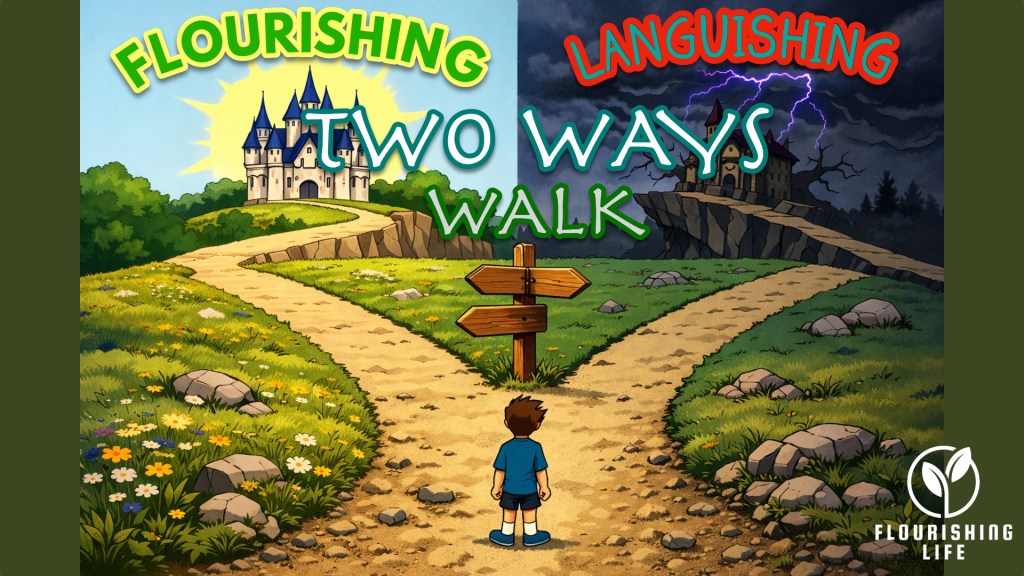
Last time, we looked at what Jesus said about the fact that there are two ways. A narrow way that leads to life and a wide way that leads to destruction. But you don’t experience those two ways all at once. You experience them as a walk.
Step by step. Choice by choice. Day by day.
Today we’re going to dive into the Old Testament as we examine the Two Ways Tradition beginning with Psalm 1.
“Blessed is the man…” (Psalm 1: 1a ESV)
Other words used in other translations for “blessed” are “happy,” or “ joyful. Tim Mackie, at the BibleProject, translates it this way: “How good life is…”
It’s interesting to note, the psalm, at its core, is descriptive and then the implication of the psalm is prescriptive. The psalm opens like a wisdom declaration, not a command:
“Blessed is the man…” That’s not “Be blessed” or “You should…”
It’s closer to: “This is what the flourishing person looks like.” “Here is the kind of life that actually works, that gets you to your ultimate goal: happiness, blessedness, the good life, a life of meaning and fulfillment.”
This fits the broader tone of wisdom literature in the Old Testament. It observes reality under God’s direction, rather than issuing direct commands.
So the psalmist is saying:
There is a way of life that leads to stability (tree). There is a way that leads to instability (chaff).
It’s describing how the world is morally structured under God’s providential care.
But here’s the turn—once you describe the good life clearly enough, it becomes implicitly directive. If one path leads to rootedness, endurance, fruitfulness, then the other leads to drift, instability, and loss. The text is quietly asking: “On which path are you walking?”
Back to the Psalm:
“Blessed is the man
who walks not in the counsel of the wicked,
nor stands in the way of sinners,
nor sits in the seat of scoffers…” (Psalm 1:1 ESV)
Notice this: Walk. Stand. Sit.
It’s not random. It’s a progression. It’s building a way of life. You can build a way of life that is blessed, or you can go in a different direction.
Notice it’s stated negatively: you don’t walk, don’t stand, don’t sit.
The psalmist is contrasting the way of the blessed with the way of the wicked. Now, that’s a harsh word in some ears, but it’s a biblical word for those who have rejected God’s loving leadership, those who rebel against God’s ways to do their own thing.
Generally, though, this rejection isn’t a one time, watershed experience. It’s gradual. They start by taking in the wrong input.
Then they stand—begin to linger in the way of sinners. Then they sit–they settle into it. And before long, it’s not just what they do. It’s who they are. It starts with small, repeated decisions shaped by bad input. That’s how the path works, and then, you just keep walking in the wrong direction.
We can look to Proverbs for more enlightenment on the Two Ways:
Proverbs 4:18-19 says:
“The path of the righteous is like the light of dawn,
which shines brighter and brighter until full day.
The way of the wicked is like deep darkness—
they do not know over what they stumble” (ESV)
One path gets clearer. The other gets darker. You don’t suddenly end up in the dark. You drift there.
Here’s something I find fascinating. The philosopher Aristotle saw part of this clearly. He said: You become what you repeatedly do.
Virtue is a habit. Character is formed over time. And that leads to flourishing—what he called eudaimonía.
That lines up with Psalm 1 rather well. The divergence is in how you get there. Aristotle believed that flourishing requires wealth, status, and leisure.
He basically says: If you don’t have those things the good life is going to be very hard—probably impossible. Which means, in practice: The good life is for the few.
And one more thing: In Aristotle’s way of thinking, it’s all on you. Your discipline. Your effort. Your ability to shape yourself into something better.
But Psalm 1 offers a radically divergent vision.
“But his delight is in the law of the Lord,
and on his law he meditates day and night” (Psalm 1:2 ESV)
This person isn’t self-creating. He’s receiving. He’s being shaped by something outside of himself.
He delights in it. He returns to it. He meditates on it.
What is “it”? The Word of God. The instruction of the Lord.
What you delight in is what you dwell on. And what you dwell on is what shapes your walk.
And then there’s this picture:
“He is like a tree
planted by streams of water
that yields its fruit in its season,
and its leaf does not wither.
In all that he does, he prospers” (Psalm 1:3 ESV)
A tree doesn’t generate its own life. It draws from a source. It’s rooted. It’s sustained. The good life is a life sourced in something outside itself.
Just as a tree planted by streams of water is fruitful, drawing life from what flows to its roots, so the person whose life is shaped by God’s Word becomes fruitful and prospers, experiencing the flourishing life.
That’s the difference.
Aristotle says: Become happy through effort. Psalm 1 says: Discover the blessed life by being rooted.
And then psalmist explains the contrast:
“The wicked are not so,
but are like chaff that the wind drives away” (Psalm 1:4 ESV).
No roots. No substance. No staying power. No one has to destroy it. It just doesn’t last.
So here’s the question: What is shaping your walk?
Because one path says: “It all depends on you.” The other says: “Abundant life available to you.”
You don’t just choose a path once. You walk it. And what you walk in is what you become.
You can watch the video version of this post here: https://youtu.be/NQiqP7cRZHI



 Flourishing Life
Leave a comment