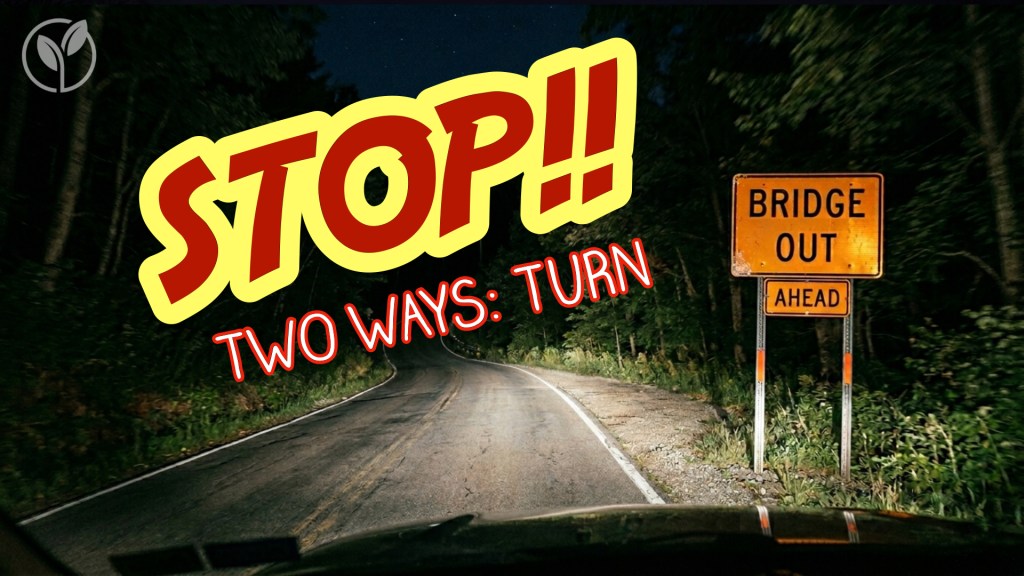
Imagine you’re driving down a quiet back road at night. No traffic. No streetlights. Just your headlights cutting through the dark. Then you see a sign: “Bridge Out.”
You hesitate. Maybe it’s old. Maybe it doesn’t apply anymore. Maybe you can make it.
But that sign isn’t a suggestion.
You can ignore it and keep going, or you can stop, turn around, and deal with what feels like an inconvenience. Because pushing forward doesn’t fix what’s broken ahead. Sometimes the smartest move isn’t pressing on.
It’s turning around before you run out of road.
The Two Ways (Revisited)
This idea runs all through Scripture. It’s called the Two Ways Tradition.
Jesus said there are two ways—a narrow way that leads to life and a broad way that leads to destruction (Matthew 7:13–14).
Psalm 1 shares a similar message: there is a blessed path and a wicked path.
The prophet Jeremiah puts it plainly:
“Behold, I set before you the way of life and the way of death” (Jeremiah 21:8b ESV).
Two ways. Two directions. Two outcomes.
What Do You Do When You Discover You’re on the Wrong Road?
You turn.
That’s the word Scripture uses:
“Turn back and turn away from all your transgressions, so that iniquity may not become a stumbling block to you” (Ezekiel 18:30 LSB).
Two movements: Turn back (return) and Turn away.
We usually call that repentance. But let’s be honest—most of us hear that word and immediately think negative.
Guilt. Shame. Failure.
That’s partly because of how we’re wired.
We have what psychologists call a “negativity bias”—we’re naturally attentive to threats, problems, what’s wrong. It’s why bad news dominates the headlines. “If it bleeds, it leads.”
Social media runs on the same fuel: negative content produces higher engagement which produces more ad revenue.
So when we hear “repent,” we hear loss. But Scripture presents it as something else entirely.
Repentance Is Not Just Turning Away
Here’s where it gets interesting. In Hebrew, you have this idea of turning back then turning away. With our negativity bias this seems contradictory. Wouldn’t you first need to turn away from evil and then turn to God?
But when you layer in the New Testament word for repent—metanoeō—it’s starts to come together in a clear new way.
It means: “to change your way of thinking.” Your perspective. Your inner orientation.
And here’s the logic: When your mind is renewed—when you begin to see clearly—your heart turns.
And when your heart turns toward God, your life naturally turns away from what’s destroying you.
In other words: You don’t just grit your teeth and walk away from sin. You see something better—life-giving, loving, and turn toward it. And that changes everything.
Turn and Live
This is why the prophets say it the way they do: “Turn and live.”
Not: “Turn… and feel bad.” “Turn… and clean yourself up.”
Turn… and live.
Because staying on the wrong road has consequences.
Scripture is blunt about that: “There is a way that seems right to a man, but its end is the way to death” (Proverbs 14:12 ESV).
This is the way that makes sense. It’s the default setting. It’s what most people are doing.
And that’s exactly the problem.
Jesus presses it even further: “What does it profit a man if he gains the whole world and forfeits his soul?” (Matthew 16:26 ESV).
You can be successful and still be heading for a collapsed bridge.
No Sunk-Cost Fallacy in the Kingdom
One of the reasons we don’t turn is simple: We think we’ve already gone so far. We’ve invested too much. We’ve made too many decisions. We’ve built too much of our life on this road. So we keep going.
That’s called the “sunk-cost fallacy.” And it will ruin you. Because distance traveled in the wrong direction doesn’t make it the right direction. It just means you’re closer to the edge.
Spiritually speaking, there’s no advantage to doubling down on a bad path. There is only wisdom in turning.
Even Good Habits Won’t Save You on the Wrong Road
You can have discipline. You can have habits. You can even have success. There’s the old adage, “What if you climb the ladder of success only to discover it’s leaning against the wrong wall?”
Even the best habits won’t save you if you’re on the wrong road. Direction matters more than effort. Always.
The Hope of Turning
This is why “turn” might be the most hopeful word in Scripture. Because it means:
You are not stuck. You are not locked in. You are not doomed to continue as you are.
You are one turn away from a different trajectory. A different life. A different ending.
Back to the Road
That sign—“Bridge Out”—is not there to ruin your night. It’s there to save your life. Turning around may feel inconvenient. It may feel costly. It may feel like failure.
But it’s not. It’s wisdom. It’s clarity. It’s the beginning of life.
The most hopeful word in Scripture is “turn.”
Watch the video version here: https://youtu.be/M2-ztWQg2_w








Leave a comment