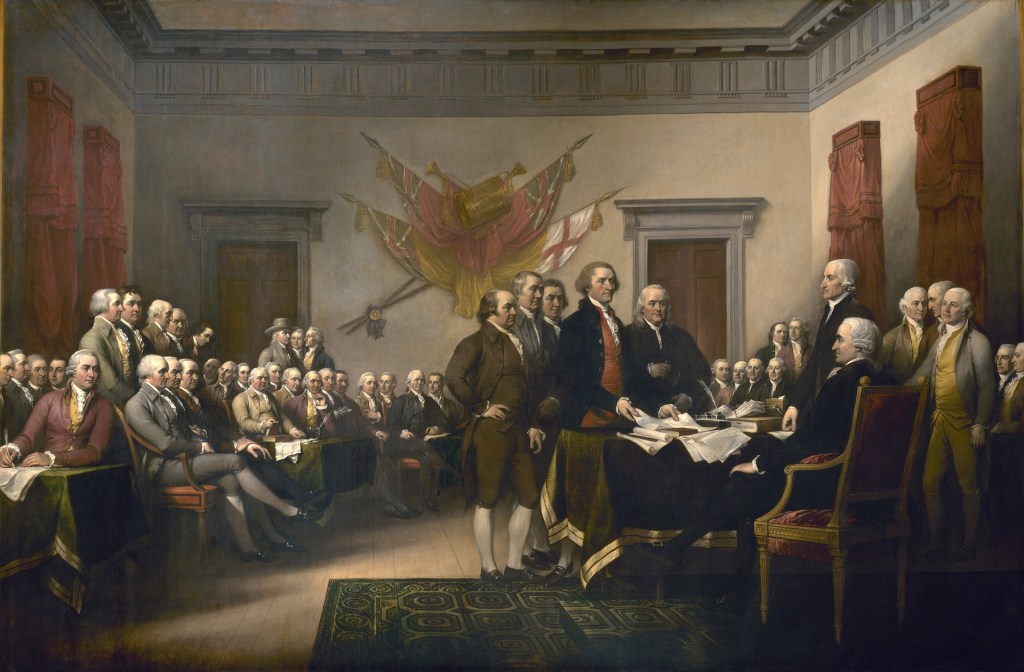
“We hold these truths to be self-evident, that all men are created equal, that they are endowed by their Creator with certain unalienable Rights, that among these are Life, Liberty and the pursuit of Happiness.”
This is one of the most famous sentences of English prose ever written. Penned by Thomas Jefferson in the Declaration of Independence, it stands at the heart of the foundational document of our great republic, whose 250th birthday we will celebrate this week.
This sentence isn’t merely ornamental. It’s not political poetry used to dress up a revolution. It is the thesis statement of the Declaration of Independence.
The central claim is this: human beings possess equal dignity and inherent rights because we are created by God. Government exists not to grant those rights but to secure them. That is the moral foundation of the American experiment.
Rights Derived from God
The United States of America is a Christian nation. Our founding document declares it so.
Not because every American has been Christian. Not because every founder was equally orthodox in his theology. Not because America has always lived up faithfully to its founding claims. We know better than that. The history of our nation includes both glory and grief, courage and contradiction, liberty and hypocrisy.
But at the level of foundation, the moral claim of the Declaration is unmistakable. The American experiment rests on the conviction that human beings are created by God, endowed with rights by God, and therefore must not be ruled as the property of kings, parliaments, parties, mobs, or states.
Rights do not come from government. Rights come from God.
Government does not create them. Government recognizes and secures them.
This is why the Declaration remains so powerful. It recognizes human dignity beyond the reach of human permission. If rights come from the state, then the state may take them away. If rights come from popular opinion, then rights rise and fall with the mood of the crowd. If rights come from political power, then the powerful will always have more of them.
But if rights come from God, then no king may erase them, no legislature may abridge them, and no court may nullify them. They are unalienable because they are granted by the Creator.
Created Equal Before God
The Declaration doesn’t begin with government. It begins with God. It doesn’t begin with human autonomy. It begins with divine authority. It doesn’t begin with self-expression. It begins with the created order.
“All men are created equal” doesn’t mean all people are equal in ability, wisdom, virtue, wealth, strength, or achievement. Plainly, we’re not. It means something more fundamental and more durable. We are equal in dignity because we are created by God.
Human dignity is not earned. It’s bestowed.
It’s not based on race, class, intelligence, citizenship, productivity, usefulness, popularity, or power. It’s grounded in creation. Every person bears a dignity that government must respect because every person stands before the God who created them.
This is the moral engine of the Declaration.
What the Pursuit of Happiness Means
That is why the next line carries such weight: “Life, Liberty and the pursuit of Happiness.”
When modern Americans hear “the pursuit of Happiness,” we often reduce it to personal preference. Happiness becomes whatever makes me feel good, whatever satisfies my desires, whatever affirms my identity, whatever allows me to do what I want.
But Jefferson was drawing from a much richer moral vocabulary. In the natural-law and moral-philosophy tradition behind the Declaration, happiness did not mean shallow pleasure or private indulgence. It meant something closer to human flourishing.
Happiness is the good life, the rightly ordered life. The life of virtue, worship, responsibility, family, work, community, liberty, and moral purpose lived under the providential care of God.
This is quite different from the thin modern version of happiness. The Declaration is not saying, “You have the right to do whatever makes you feel good.” That is not liberty. That is appetite with a patriotic paint job.
The Declaration is saying that God has created human beings with dignity and has endowed them with the rights necessary for pursuing the life for which he made them.
The Right to Pursue, Not the Guarantee to Possess
God gives us the right to pursue happiness. He doesn’t guarantee happiness as an automatic possession.
Happiness is not dropped into our laps. It is not manufactured by the state. It is not delivered through endless consumption. It is not produced by entertainment, distraction, self-indulgence, or the unchecked satisfaction of every desire.
Government can protect the space for the pursuit. It cannot make the pursuit for us.
The state can protect religious liberty. It cannot worship for us.
The state can protect speech. It cannot make our speech truthful.
The state can protect property. It cannot make us generous.
The state can protect the family. It cannot make us faithful.
The state can protect liberty. It cannot make us virtuous.
That work belongs to persons, families, churches, communities, and ultimately in cooperation with God’s grace.
Liberty Without Moral Vision
This is where modern America often loses its way. We want the fruit of liberty without the form of virtue. We want the blessings of freedom without the burden of moral responsibility. We want happiness without holiness, rights without righteousness, liberty without limits.
But without a moral vision, liberty bends inward on itself and becomes bondage.
Freedom isn’t merely the absence of restraint. A person can be free from external control and still be enslaved to appetite, pride, envy, greed, lust, addiction, anger, fear, ideology, or ego.
A nation can have laws protecting liberty while its people lose the capacity to live freely.
That is the danger before us.
Liberty detached from truth does not lead to happiness. It leads to confusion. Liberty detached from virtue does not produce flourishing. It repackages captivity as self-expression.
We are watching this happen all around us. A culture that defines freedom as self-invention leaves people with the terrible burden of self-rule without a moral compass. A people taught to follow every desire become ruled by their desires. A society that rejects moral order does not grow free from order. It simply submits to disorder.
What Will Govern Us?
No one lives without being governed. The only question is what will govern us.
Will we be governed by God or appetite? By truth or impulse? By virtue or by vice? By wisdom or fashion? By the Creator or by the crowd?
The Declaration’s vision of liberty assumes a moral universe. It assumes that human beings are not accidents. We are not animals with preferences. We are not consumers with appetites. We are not servants of the state. We are creatures made by God in the image of God.
That means the pursuit of happiness is ultimately a spiritual pursuit. It is the pursuit of a rightly ordered life under the loving leadership of God.
The Foundation America Must Remember
America’s founding claim depends upon truths Christianity gave to the world: creation, human dignity, moral order, divine providence, human accountability, and liberty.
Without those truths, the American experiment loses its foundation.
If there is no Creator, then “created equal” becomes a poetic phrase without metaphysical weight. If rights are not endowed by God, then rights must be granted by man. If rights are granted by man, then they may be withdrawn by man. If liberty has no moral purpose, then liberty just becomes permission. If happiness is disconnected from virtue, it collapses into the unrestrained pursuit of pleasure.
And pleasure is a poor substitute for flourishing.
That is why this 250th anniversary should be more than a patriotic celebration. It should be an act of remembrance.
We should remember that America was born from a claim about God before it was a claim about government.
We should remember that liberty is not self-salvation.
We should remember that rights are sacred and God granted them.
We should remember that government is limited but God is not.
We should remember that happiness is not the same as indulgence.
And we should remember that a free people must also be a morally formed people.
Gratitude and Responsibility
This should lead us to gratitude.
Gratitude for those who had the courage to say that rights come from God, not kings. Gratitude for a nation built on the conviction that government exists to secure liberty, not manufacture meaning. Gratitude for the freedom to worship, speak, work, build, reform, serve, and pursue the good.
But gratitude should also lead to responsibility.
If God has given us liberty, then liberty must be stewarded. If God has endowed us with rights, then rights must be defended. If God has made happiness possible, then happiness must be pursued rightly.
The future of America does not depend on better politics. Politics matter, but politics cannot bear the weight of the human soul. The future of America depends on recovering the moral and spiritual vision that made liberty intelligible in the first place.
We need more than citizens who demand their rights. We need citizens who know why rights exist.
We need more than people who celebrate freedom. We need people who know what freedom is for.
We need more than the pursuit of pleasure. We need the pursuit of happiness rightly understood.
The Pursuit Still Before Us
The Declaration does not promise an easy life. It does not promise comfort, pleasure, success, or national perfection. It gives us something better and harder: a vision of human beings created by God, endowed with rights by God, and set free to pursue the good life under God.
That pursuit remains before us.
To pursue happiness rightly is to pursue the life God made us for. It is to seek liberty ordered by truth, freedom formed by virtue, and national life grounded in gratitude to the Creator.
America was born from the conviction that our rights come from God.
If we would remain free, we must remember that happiness does too. The pursuit of happiness is not the chase for whatever pleases us. It is the free and grateful pursuit of the life for which God created us.
Watch the video version:









Leave a comment